
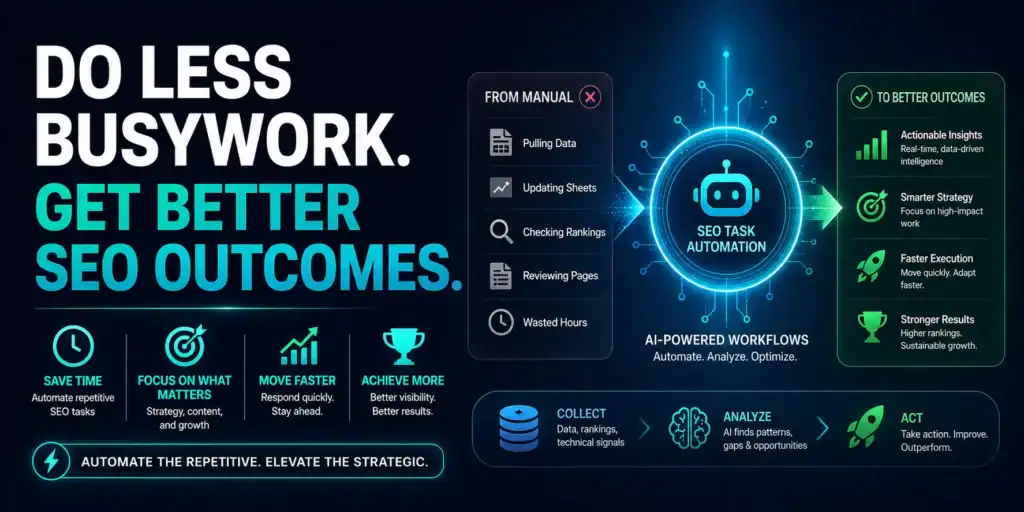

Most SEO teams aren’t short on ideas—they’re short on time.
You spend hours pulling data, updating sheets, checking rankings, and reviewing pages. Yet the work that actually moves performance—strategy, content depth, experimentation—gets pushed aside.
This is where SEO task automation makes a real difference.
SEO task automation uses tools and AI to handle repetitive SEO workflows so teams can focus on strategy and growth.
Without automation, teams spend hours on manual tasks that don’t directly improve rankings.
With the right workflows, you remove that friction and move faster.
This guide covers practical SEO automation workflows you can implement immediately using AI.
What Is SEO Task Automation?
SEO task automation is the use of tools and AI to automate repetitive SEO workflows such as keyword clustering, rank tracking, reporting, and technical monitoring—improving efficiency and enabling faster decision-making.
Why SEO Task Automation Matters Now
SEO has become more complex:
- More pages to manage
- More data to process
- Faster ranking changes
- AI-driven search layers
Manual workflows don’t scale anymore.
If your team is still handling repetitive tasks manually, you’re not just losing time—you’re limiting how fast you can respond to changes.
What Makes This Guide Different
Most SEO automation guides focus on tools.
This guide focuses on workflows—what to automate, why it matters, and how to do it effectively using AI prompts.
The goal isn’t just saving time—it’s improving how SEO work gets done.
A Simple Way to Think About SEO Automation
You can divide SEO automation into three layers:
- Data Collection: Tracking rankings, crawling sites, gathering keyword data
- Analysis: Identifying patterns, gaps, and opportunities
- Execution Support: Generating suggestions, drafts, and recommendations
Most teams automate the first layer.
High-performing teams automate all three.
Manual SEO vs Automated Workflows: What Actually Changes
Here’s how manual SEO compares to automated workflows in practice:
| Aspect | Manual SEO | Automated SEO Workflows |
|---|---|---|
| Keyword Clustering | Time-consuming, inconsistent | Fast, intent-based grouping with AI |
| SERP Analysis | Manual review of each page | Pattern extraction across competitors |
| Reporting | Delayed, repetitive | Real-time, automated insights |
| Issue Detection | Reactive | Proactive alerts and monitoring |
| Content Optimization | Slow, manual audits | AI-assisted gap analysis |
| Scalability | Limited by team bandwidth | Scales across pages and keywords |
| Decision Speed | Slower | Faster, data-driven decisions |
- Quick Reality Check
- If you’re still manually handling clustering, reporting, and content reviews—you’re maintaining SEO, not improving it.
- The advantage isn’t doing more—it’s removing what shouldn’t be manual.
- Key takeaway:
- Manual SEO maintains performance. Automated workflows help you improve it consistently.
8 SEO Tasks You Should Automate (And How to Do It Right)
These are the tasks where automation delivers immediate impact.
1. Keyword Clustering & Intent Mapping
The problem:
Manually grouping keywords takes hours and often misses intent overlap.
Automation approach:
Use AI to cluster keywords based on semantic similarity and search intent.
Why it matters:
You get clearer content direction faster—and avoid creating duplicate or competing pages.
AI Prompt:
You are an SEO strategist.
Group the following keywords into clusters based on search intent (informational, commercial, transactional, navigational).
For each cluster, suggest:
– Primary keyword
– Supporting keywords
– Ideal content type (blog, landing page, comparison, etc.)
– Funnel stage
Keywords: [paste list]
2. SERP Analysis & Competitor Snapshots
The problem:
Reviewing top-ranking pages manually for every keyword is slow and inconsistent.
Automation approach:
Set up workflows that extract:
- Page structure
- Common headings
- Content depth patterns
Result:
You quickly identify structural and intent patterns consistently present in top-ranking pages—without reading every page line by line.
This helps you quickly understand what Google is rewarding for that keyword.
This workflow aligns closely with our detailed guide on AI-assisted SEO competitor analysis, where content structure and intent patterns are analyzed at scale.
AI Prompt:
Act as an AI-first SEO strategist.
Analyze the top-ranking pages for the keyword: [target keyword]
URLs:
[paste top 5–10 ranking URLs]
Extract and summarize:
- Page Structure Patterns
– Common H1 formats
– Recurring H2/H3 themes
– Section sequencing trends
- Content Depth Analysis
– Average word count range
– Depth of coverage (basic/intermediate/comprehensive)
– Use of examples, data, or case studies
- Search Intent Alignment
– Dominant intent (informational/commercial/transactional)
– Any mixed intent patterns
- Content Features
– Use of FAQs, tables, lists
– Visual elements (images, videos, infographics)
– Internal linking patterns
- Differentiation Gaps
– What competitors are missing
– Underserved angles or questions
– Opportunities to create better content
Output:
– Clear bullet summary
– “What Google is rewarding” insight
– 3–5 actionable recommendations for outranking competitors
(Note: Try this on one keyword before moving to the next workflow.)
3. Technical SEO Monitoring
The problem:
Catching crawl errors, broken links, or indexing issues manually is reactive.
Automation approach:
Use automated crawlers and alerts for:
- 404 errors
- Redirect chains
- Indexing changes
Result:
Issues get flagged early—before they impact rankings.
AI Prompt:
Act as a technical SEO consultant.
Summarize the following SEO audit report into:
– Critical issues (fix immediately)
– Medium priority issues
– Low priority improvements
– Actionable fixes in simple terms
Audit Data: [paste report]
4. Rank Tracking & Reporting
The problem:
Pulling ranking reports manually wastes time and often delays decisions.
Automation approach:
Automate:
- Daily or weekly rank tracking
- Trend summaries
- Alert-based reporting
Result:
You focus on movement, not data collection.
AI Prompt:
Act as an SEO performance analyst.
Analyze the following rank tracking data and generate a clear summary.
Data: [paste keyword rankings with dates/positions]
Output:
– Top ranking improvements (keywords that moved up significantly)
– Major drops (keywords losing positions)
– Stable performers (consistent rankings)
– New keyword entries (recently ranking)
Also include:
– Overall trend summary (improving, declining, volatile)
– Possible reasons for changes (algorithm updates, competition, content changes)
– 3–5 actionable recommendations based on the data
Keep it concise and insight-driven, not just descriptive.
5. Content Optimization Suggestions
The problem:
Reviewing content gaps manually across pages is slow.
Automation approach:
Use AI to analyze:
- Missing subtopics
- Weak sections
- Readability issues
Result:
Faster content improvement cycles.
This approach aligns with broader AI-first SEO strategies focused on content depth and intent coverage.
AI Prompt:
Act as an AI-first SEO content strategist.
Analyze the following content for the target keyword: [target keyword]
Content:
[paste your content]
Compare it against what a high-ranking page should include.
Identify:
– Missing subtopics or questions not covered
– Weak or shallow sections
– Redundant or low-value content
Also provide:
– Suggested new sections to add
– Specific improvements for weak sections
– Content restructuring recommendations
Output:
– Gap summary
– Section-wise improvement suggestions
– Priority fixes (high/medium/low)
6. Internal Linking Opportunities
The problem:
Finding relevant internal links manually across large sites is inefficient.
Automation approach:
Use tools to:
- Suggest contextual links
- Identify orphan pages
- Map topic clusters
Result:
Stronger site structure without manual scanning.
AI Prompt:
You are a technical SEO expert.
Analyze the following content and suggest:
– Relevant internal linking opportunities
– Anchor text suggestions
– Target pages to link to
– Orphan pages (if any)
Content: [paste content]
Website Pages: [paste URLs or sitemap]
7. Meta Tags & Snippet Optimization
The problem:
Writing or updating meta titles/descriptions at scale is repetitive.
Automation approach:
Generate drafts using AI, then review and refine.
Result:
Faster updates without compromising quality.
AI Prompts:
Act as an SEO copywriter.
Generate 5 high-CTR meta titles (max 55 characters) and 5 meta descriptions (max 150 characters) for:
Page Topic: [topic]
Target Keyword: [keyword]
Focus on curiosity, clarity, and intent match.
Avoid clickbait.
You are a structured data expert.
Generate JSON-LD schema markup for:
Page Type: [blog/product/local business/etc.]
Content: [paste content]
Ensure it follows Google guidelines and includes all relevant properties.
8. Performance Alerts & Anomaly Detection
The problem:
You notice traffic drops too late.
Automation approach:
Set alerts for:
- Sudden ranking drops
- Traffic anomalies
- CTR changes
Result:
Faster reaction to algorithm updates or issues.
This becomes critical during ranking volatility—especially during major algorithm updates like recent Google core updates.
AI Prompt:
Act as an SEO analyst.
Analyze the following Google Search Console data and explain:
– Possible reasons for traffic drop
– Keyword-level impact
– Page-level issues
– Suggested recovery actions
Data: [paste queries/pages/impressions/clicks]
What You Should NOT Automate
Automation is powerful—but not everything should be automated.
If everything is automated, nothing is differentiated.
Avoid automating:
- Content strategy decisions
- Final content writing without review
- Brand messaging
- Complex technical audits require judgment
Automation should support thinking, not replace it.
A Practical Way to Start
Don’t try to automate everything at once.
Start with:
- Rank tracking
- Keyword clustering
- Technical alerts
These deliver immediate time savings.
Then expand into deeper SEO automation workflows as your processes mature.
Real-World Example
A mid-sized B2B content team reduced manual workload by:
- Automating keyword clustering
- Setting up weekly rank reports
- Using AI for content gap analysis
Result:
- 40–50% less time on reporting
- Faster content production cycles
- Better alignment between SEO and content teams
The key difference wasn’t effort—it was removing repetitive work.
How SEO Task Automation Fits into AI-First SEO
As search evolves, speed matters.
You need to:
- Identify trends faster
- Update content quicker
- Respond to ranking changes immediately
Automation enables that.
It also supports Agentic engine optimization (AEO), where structured, well-maintained content improves visibility in AI-driven results.
Where to Start (Quick Action Plan)
- Pick one workflow (rank tracking or clustering)
- Apply one AI prompt from this guide
- Test it on one page or keyword set
- Measure time saved and output quality
Don’t optimize everything at once. Start small and scale what works.
Final Thought
SEO doesn’t reward effort—it rewards clarity, speed, and usefulness.
If your workflow is still manual, you’re spending time in the wrong places.
Automation doesn’t replace expertise.
It gives you more space to use it where it matters.
Start with one workflow.
Then build from there.
Frequently Asked Questions: SEO Task Automation
What is SEO task automation?
It’s the use of tools and workflows to automate repetitive SEO tasks like reporting, monitoring, and data analysis.
Which SEO tasks should be automated first?
Start with rank tracking, keyword clustering, and technical monitoring for immediate efficiency gains.
Can automation improve SEO performance?
Indirectly, yes. It frees up time for strategy and optimization, which drives better results.
Is AI necessary for SEO automation?
Not always, but AI significantly improves tasks like clustering, content analysis, and intent mapping.
What tools are commonly used for SEO automation?
Various SEO platforms, crawlers, and AI tools, depending on workflow needs.
Can small teams benefit from SEO automation?
Yes. In fact, smaller teams often benefit the most by saving time and scaling output.
What are the risks of over-automation?
Loss of quality, missed nuances, and incorrect decisions if human oversight is removed.
How does automation help with algorithm updates?
It allows faster detection of changes and quicker response to ranking shifts.
Should content creation be automated?
No. AI can assist, but human review is essential for accuracy and depth.
What’s the long-term role of automation in SEO?
Automation will handle execution, while humans focus on strategy, creativity, and decision-making.
Is SEO automation worth it for small teams?
Yes. It helps small teams save time on repetitive tasks and focus on strategy, content, and faster execution.
How do I start SEO automation without tools?
Start with AI prompts for keyword clustering, content analysis, and reporting. Add tools later as needed.