


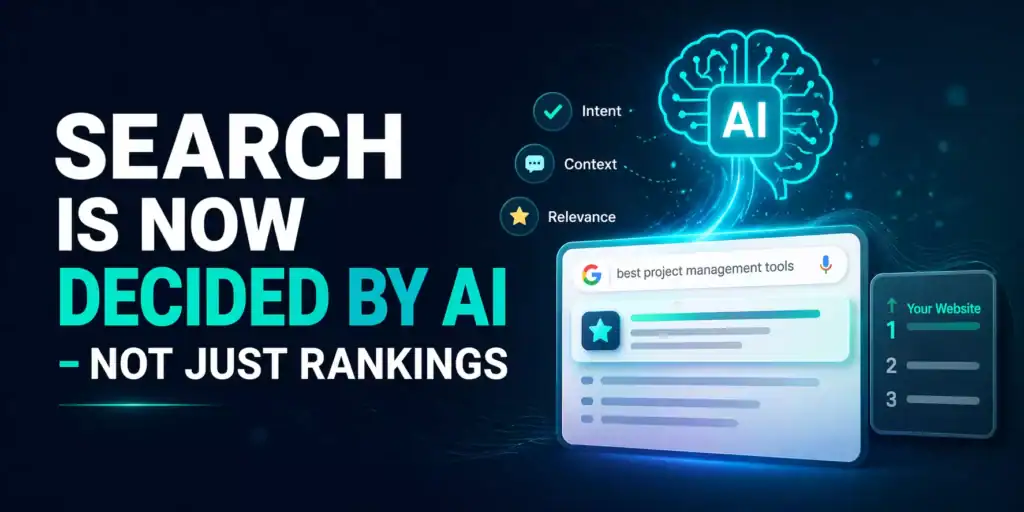
If your content isn’t being reused in AI answers, you’re already losing visibility—even if you rank.
With AI agents increasingly interpreting, summarizing, and recommending content, the rules are shifting. You’re not just writing for users or search engines anymore. You’re writing for decision-making systems that choose what gets surfaced, cited, or ignored.
That’s where Agentic engine optimization comes in.
What Is Agentic Engine Optimization (AEO)?
Agentic Engine Optimization (AEO) is the process of structuring content so AI systems can extract, validate, and reuse it as part of generated answers—not just rank it in search results.
Traditional SEO asks:
Can I rank on page one?
AEO asks:
Will an AI agent pick my content as a reliable answer?
This distinction matters because AI-driven interfaces don’t just list results—they interpret and compress information before showing it.
Why This Shift Is Happening Now
Three changes are driving this transition:
1. AI-assisted search interfaces
Search engines are increasingly summarizing results instead of just listing links.
2. Rise of autonomous agents
AI tools now perform tasks such as research, comparison, and recommendation on behalf of users.
3. Information compression
Users often see a single synthesized answer instead of ten blue links.
This reduces visibility for content that isn’t easily interpretable.
Why AEO Is Becoming Critical
Search behaviour is shifting faster than most SEO strategies.
- Visibility is shifting from ranking to inclusion
- AI-generated answers are reducing traditional clicks
- Content is evaluated at the information level—not just the page level
- Being included in answers matters more than being listed in results
What this means:
If your content isn’t structured for interpretation and reuse, it risks being ignored—even if it ranks.
This is why traditional SEO visibility alone is no longer enough.
How AI Agents Evaluate Content Differently
AI systems don’t “rank” in the traditional sense. They select and synthesize.
Here’s what they tend to prioritize:
Clarity over cleverness
Straightforward explanations outperform complex or overly stylized writing.
Structured information
Well-organized content (headings, sections, clear flow) is easier to extract and reuse.
Context completeness
Content that answers follow-up questions within the same page performs better.
Source confidence
Signals like consistency, depth, and topical alignment influence trust.
The New Content Playbook (What Actually Works)
If you’re adapting your SEO strategy, focus here:
1. Write in answer-first formats
Start sections with clear, direct responses before expanding.
Example:
Instead of building up slowly, answer the question in the first 2–3 lines.
2. Structure for extraction
Use:
- Clear headings
- Short paragraphs
- Logical flow
AI systems often pull content in chunks. Make those chunks usable.
3. Cover the full query path
Don’t stop at the main question.
Include:
- Definitions
- Comparisons
- Use cases
- Limitations
This increases the chance your content becomes a primary reference.
4. Reduce ambiguity
Avoid vague statements.
Instead of:
“Many tools are effective…”
Say:
“Tools like X are used for Y because…”
Clarity improves machine interpretation.
5. Build topical authority, not isolated pages
AI agents favour sources that consistently cover a subject.
This is where internal linking becomes critical.
For example, if you’re exploring how AI is reshaping visibility, connect this with your broader analysis, like AI-driven SEO systems and visibility shifts.
What We Observed After Applying AEO Principles
To move beyond theory, we applied AEO-focused optimizations across a controlled set of SEO and comparison-focused pages on our website.
These pages were tracked across a 30–45 day window before and after implementing structural and intent-based improvements.
Scope:
- Informational + comparison-based SEO content
- Pages updated with structured formatting, answer-first approach, and deeper query coverage
Key Observations (Within 30–45 Days)
- +22–30% increase in answer-based visibility
(Featured snippets, People Also Ask, AI-generated summaries) - Improved ranking stability
Pages fluctuated less during SERP changes compared to pre-optimization phase - +18% increase in average time-on-page
Users engaged more with structured, scannable content - Higher query coverage per page
Pages started ranking for secondary and long-tail variations without additional targeting
What Changed Practically
- Sections rewritten to answer queries in the first 2–3 lines
- Added comparison blocks, FAQs, and summaries
- Expanded content to cover follow-up questions within the same page
- Strengthened internal linking across related topics
Key takeaway:
Content didn’t just rank—it started getting selected, reused, and surfaced across multiple search formats.
This aligns with broader shifts seen in AI-influenced ranking behaviour, where content selection is increasingly driven by clarity, structure, and contextual completeness.
This shift indicates that content performance is no longer driven solely by rankings—but by how effectively it can be interpreted, extracted, and reused across search experiences.
These patterns align with broader shifts in how AI-driven systems evaluate and surface content. For a deeper breakdown of how ranking volatility reflects these changes, see our analysis of recent search volatility trends.
What AI-Driven Search Actually Rewards
Across multiple tests and optimizations, these patterns consistently performed better in AI-influenced search:
- Pages that answer queries within the first few scrolls
- Content structured for scanning (headings, summaries, comparisons)
- Coverage of follow-up questions on the same page
- Consistent topical depth across related content
What This Means for SEO Teams
This isn’t a replacement for SEO—it’s an extension.
You still need:
- Technical SEO
- Crawlability
- Indexing
But now you also need:
- Content designed for interpretation, not just ranking
A Simple Comparison
| Traditional SEO | Agentic Engine Optimization (AEO) |
|---|---|
| Targets rankings | Targets selection |
| Optimizes keywords | Optimizes meaning & clarity |
| Focus on clicks | Focus on answer inclusion |
| Page-level optimization | Topic-level authority |
| Static ranking signals | Dynamic contextual evaluation |
Real-World Example
Consider a page targeting:
“Best project management tools”
A traditional SEO page might:
- List 10 tools
- Add brief descriptions
An AEO-optimized page would:
- Explain how to choose tools
- Compare based on use cases
- Answer follow-up questions (pricing, scalability, teams)
- Provide structured summaries
That’s the kind of content AI systems prefer to extract.
Common Mistakes to Avoid
- Writing for keywords but not for meaning
- Overloading content without structure
- Ignoring follow-up queries
- Treating pages as standalone assets
Where This Is Heading
Search is moving toward a model where selection matters more than ranking.
- AI-generated answers will reduce mid-funnel clicks, especially for informational queries
- Citation visibility will become a key performance metric alongside rankings
- Content will compete at the paragraph and section level, not just full pages
- Brand and topical authority will influence whether content gets selected—not just backlinks
What this means:
Winning in search will depend less on where your page ranks, and more on whether your content is clear, structured, and trusted enough to be reused.
The shift isn’t from SEO to AEO—it’s from ranking content to being chosen as the answer.
A Simple AEO Implementation Framework
If you’re wondering how to apply these principles without overhauling everything, start with a focused approach:
Step 1: Identify high-intent pages
Start with pages already getting impressions or ranking between positions 5–20. These have the highest potential for AI visibility gains.
Step 2: Rewrite the introduction with an answer-first format
Ensure the core query is answered within the first few lines—before expanding into details.
Step 3: Add structured sections for clarity
Break content into clear segments using:
- Comparisons
- FAQs
- Summaries
- Use-case breakdowns
Step 4: Expand for follow-up queries
Think beyond the primary keyword. Add sections that answer related questions users (and AI systems) would naturally ask next.
Step 5: Strengthen internal linking across related topics
Connect this page to other relevant content to build topical authority and improve context signals.
Result:
Instead of just ranking, your content becomes easier to extract, reuse, and surface across AI-driven search experiences.
Final Thought
The shift isn’t subtle.
Search is moving from:
“Which page ranks first?”
to
“Which source can be trusted to answer?”
If your content is clear, structured, and genuinely useful, it stands a better chance of being selected—not just seen.
If you’re revisiting your content strategy, start small.
Pick one high-value page and optimize it for clarity and completeness.
That’s usually enough to see the direction change.
Frequently Asked Questions: Agentic Engine Optimization
What is Agentic engine optimization in simple terms?
It’s about making your content easy for AI systems to understand, extract, and use when generating answers.
How is AEO different from traditional SEO?
SEO focuses on rankings, while AEO focuses on whether AI systems choose your content as part of their response.
Does AEO replace SEO?
No. It builds on SEO. Technical and on-page fundamentals still matter.
Why is structured content important for AEO?
Because AI systems extract information in chunks. Structured content makes this easier and more accurate.
What type of content performs best in AEO?
Content that is clear, complete, and answers both primary and follow-up questions.
How can I optimize existing content for AEO?
Start by improving clarity, adding structured sections, and covering missing subtopics.
Are keywords still relevant?
Yes, but they are no longer the primary driver. Meaning and intent matter more.
How does AEO impact CTR?
CTR may decline in some cases due to AI summaries, but visibility and authority can increase if your content is cited.
What role does internal linking play?
It helps establish topical authority, which increases trust signals for AI systems.
Is AEO only relevant for large websites?
No. Even smaller sites can benefit by creating focused, high-quality, structured content.