


If your rankings moved sharply in March—even on stable pages—you’re not alone.
The March 2026 Google core update didn’t just adjust rankings. It exposed how search is evolving: less about static rankings, more about dynamic evaluation influenced by AI layers, intent interpretation, and content depth.
For teams managing large websites or performance-driven SEO strategies, the key question is simple:
Was this a temporary fluctuation—or a structural shift in how Google evaluates content?
What Made the March 2026 Google Core Update Different?
Most core updates cause movement. This one felt more abrupt.
Here’s what stood out:
1. Higher-than-usual volatility across industries
Even well-established sites saw fluctuations—both upward and downward—within short timeframes.
2. Faster ranking recalculations
Instead of gradual shifts, rankings changed in waves. Pages that dropped early sometimes recovered mid-update.
3. Stronger influence of query intent interpretation
Pages matching keywords but missing intent clarity, lost visibility.
Example:
A page targeting “best CRM tools” but written as a generic list struggled against pages that clearly addressed comparisons, pricing, and real use cases.
The Bigger Shift: Search Is Becoming Context-Driven
This “March 2026 Google Core Update” reflects a deeper transition.
Google is no longer just ranking content—it’s interpreting usefulness in context.
Three signals seem stronger now:
Content depth vs. content length
Long pages didn’t automatically perform better. Pages with clear answers, structured insights, and logical flow did.
First-hand or experience-based input
Content that shows real usage, analysis, or perspective performed better than surface-level summaries.
Entity clarity and topical alignment
Pages strongly aligned to a topic cluster held more stability.
How AI Layers Are Influencing Rankings
The March 2026 Google Core Update also reflects increased integration of AI-driven evaluation.
Not in a visible interface—but clearly in how rankings behave and recalibrate in real time.
What changed practically:
- Search results are more fluid
- Ranking positions are less “fixed”
- Content is evaluated in relation to competing pages dynamically
This explains why rankings now shift even without major content changes—because competing pages are continuously re-evaluated in real time.
This aligns with broader AI search trends, where Google blends traditional ranking signals with contextual understanding.
If you’ve been following AI-driven visibility shifts, you’ll notice similarities with patterns discussed in our analysis on AI search visibility systems.
What Actually Dropped—and Why
Across multiple sites, certain patterns emerged:
Pages that lost visibility:
- Generic, templated content
- Thin affiliate or comparison pages
- Keyword-focused pages without clear user value
- Pages that hadn’t been updated recently
Pages that gained:
- Deep, structured guides
- Content answering layered queries
- Pages with strong internal linking and topical relevance
Industry volatility shows movement—but not outcomes. To understand what actually worked, we analysed our own performance across key pages.
Based on a sample of high-intent SEO and analysis pages across our website, tracking performance before and after both updates.
How We Recovered & Improved After the March 2026 Update
While industry-wide data showed increased volatility during the March 2026 core update, the more important question was: what happens after the fluctuation?
Instead of reacting immediately, we analysed performance patterns across our key pages and focused on intent alignment, content clarity, and structural improvements.
SEO Performance Trend: December 2025 vs March 2026 Update
To move beyond industry-level assumptions, we tracked keyword movement and traffic trends across our core pages before and after both updates.


The pattern is clear: while the December update caused a drop, the March update rewarded structured improvements—leading to a net positive recovery.
What this shows:
- Initial impact during the December update
- Short-term fluctuation during the March rollout
- Strong recovery and net improvement after optimisation
Ranking Recovery Timeline
- March 20–28: High volatility and ranking fluctuations
- March 28–April 5: Partial recovery across key pages
- April 5–April 20: Stabilisation phase
- Post 20th April: Consistent improvement in rankings and traffic
This pattern suggests that the update wasn’t just disruptive—it rewarded sites that adapted quickly.
It also indicates that recovery is no longer passive—Google is actively re-evaluating improved content during and after rollout phases.
What Actually Improved (Post-Update)
Pages that gained visibility:
- In-depth, structured guides
- Pages with clear comparisons and use-case breakdowns
- Recently updated content (within the last 60–90 days)
Changes implemented:
- Reworked content to better match search intent
- Improved internal linking across related topics
- Added structured sections (FAQs, summaries, comparisons)
- Updated outdated or thin content
Keyword Stability & Improvement Trends
Beyond rankings, we also measured stability—how consistently keywords held positions after fluctuations.
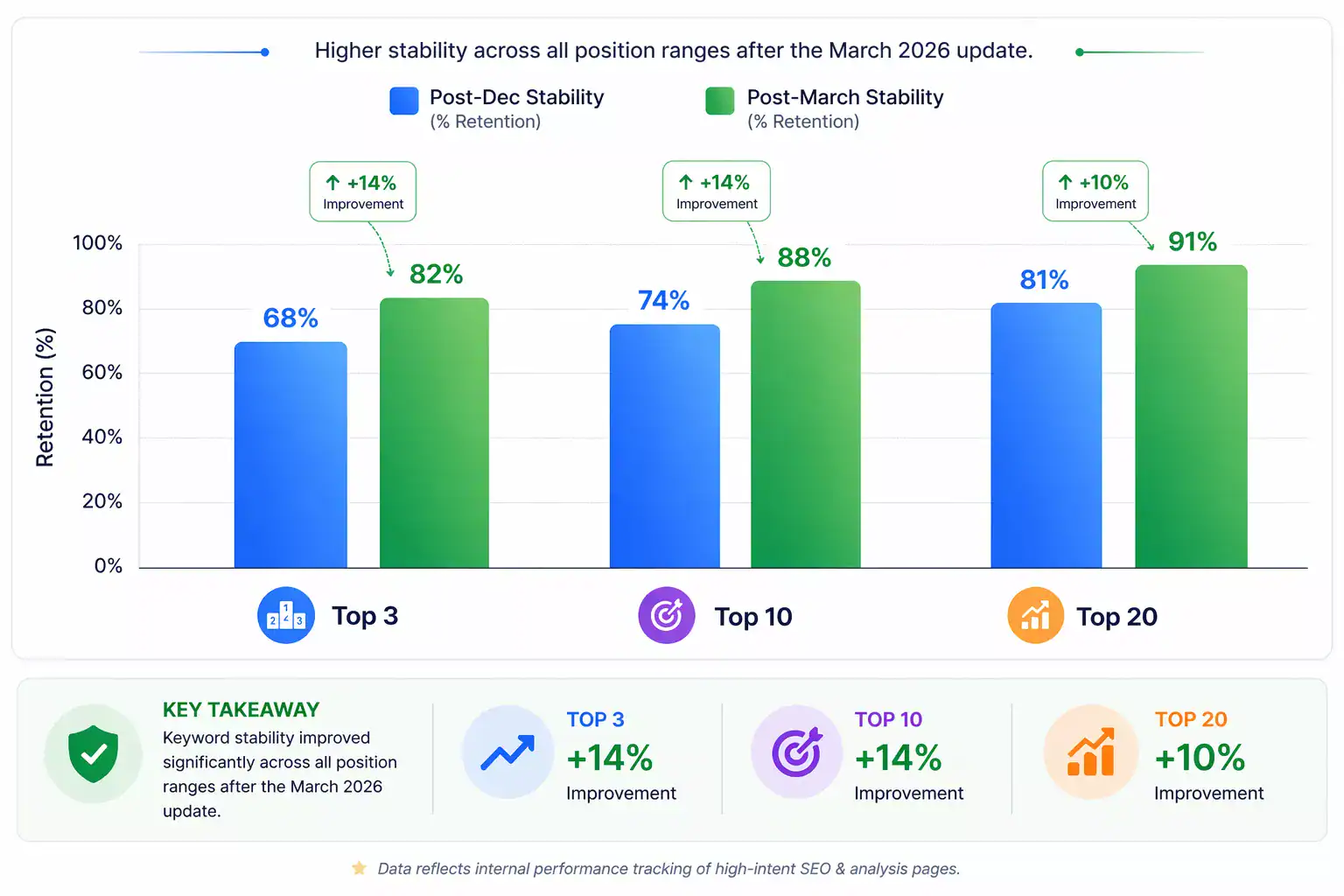
Stability gains across all ranges indicate that better-structured, intent-aligned content is now more resistant to volatility.
Key takeaway:
Ranking stability improved significantly after aligning content with intent and structure—indicating that clarity and relevance now matter more than static optimisation.
What Changed Between December & March (Our Observation)
- December update exposed weak, generic, and thin content
- March update rewarded well-structured, intent-driven pages
Key Insight: Recovery wasn’t automatic—it required deliberate content improvements aligned with intent and structure.
Unlike broad industry volatility, this data shows that sites adapting to intent-focused SEO saw measurable recovery within weeks.
What This Update Actually Rewarded
- Pages that answer the query within the first few scrolls
- Content structured for scanning (headings, comparisons, summaries)
- Updated pages with fresh context, not just refreshed keywords
- Topic clusters over isolated pages
Actionable Steps: What You Should Do Next
If your site was impacted, don’t rush changes blindly.
Start with this:
1. Re-evaluate intent, not just keywords
Ask: Does this page truly answer the search query?
2. Improve content clarity
Break complex topics into structured sections. Make answers easy to find.
3. Add real insights
Include examples, comparisons, or experience-driven inputs.
4. Strengthen topical clusters
Don’t treat pages as standalone assets. Build connected content ecosystems.
5. Monitor patterns, not daily fluctuations
Core updates settle over time. Look for consistent trends before making major decisions.
What This Means for Long-Term SEO Strategy
The direction is clear.
SEO is moving toward:
- Context over keywords
- Depth over volume
- Relevance over optimisation tricks
Teams that rely on scalable but shallow content will struggle more with each update.
Those investing in clarity, structure, and real value will see more stability.
A Simple Way to Think About It
Before this update:
“Does my page target the right keyword?”
After this update:
“Does my page solve the user’s exact problem better than others?”
That’s the shift.
Final Thought
Updates like “March 2026 Google Core Update” aren’t just disruptions—they’re signals.
If rankings dropped, it’s not always about fixing “what went wrong.”
Sometimes it’s about understanding what Google now values more than before.
If you’re reviewing your strategy post-update, start with your most important pages.
Look at them like a user would—not like an SEO.
That’s usually where the real answers are.
Frequently Asked Questions: March 2026 Google Core Update
What is the March 2026 Google core update?
It’s a broad algorithm update by Google aimed at improving how content is ranked based on relevance, quality, and usefulness rather than just keyword alignment.
Why was this update considered more volatile?
Because rankings shifted faster and more frequently during rollout, they affected even stable websites across multiple industries.
Did AI play a role in this update?
While not officially confirmed, ranking patterns suggest stronger AI-driven evaluation of content relevance and context.
How long does it take for rankings to stabilise?
Typically, core updates take 2–3 weeks to fully roll out, but ranking adjustments can continue even after that.
How quickly can rankings recover after a core update?
Recovery timelines vary, but sites that align content with intent and structure often see measurable improvements within 2–4 weeks after rollout stabilisation.
What type of content was most affected?
Generic, thin, and keyword-heavy content without depth or user-focused structure saw the most decline.
Should I update all my pages immediately?
No. Focus first on pages that lost traffic. Analyse patterns before making large-scale changes.
Are backlinks still important after this update?
Yes, but content quality and relevance now play a more significant role alongside backlinks.
How can I recover lost rankings?
Improve content clarity, match search intent better, and add real insights rather than rewriting for keywords alone.
Did this update affect all industries equally?
No. Some sectors, like affiliate, SaaS, and content-heavy niches, saw higher volatility.
What should be my long-term takeaway?
Build content that answers real user needs clearly and completely. That’s becoming the most stable SEO strategy.