


Most competitor analysis looks impressive on spreadsheets—but doesn’t change outcomes.
You pull keywords, compare traffic, and maybe audit backlinks. Yet rankings don’t move meaningfully.
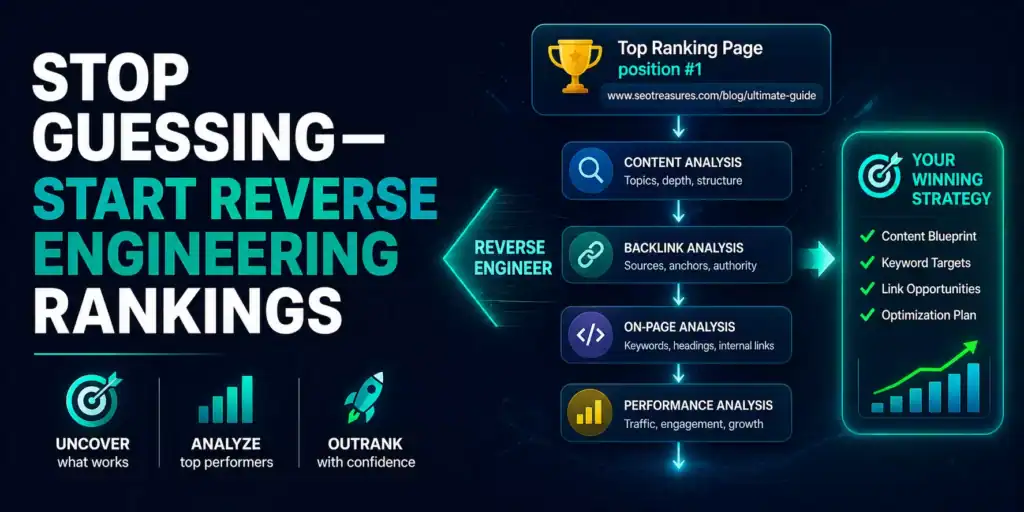
The gap isn’t in data—it’s in how you interpret content patterns, intent coverage, and structure.
AI-assisted SEO competitor analysis changes that. Not by automating reports, but by helping you decode why competitors rank—and what they do better.
What Is AI-assisted SEO Competitor Analysis?
AI-assisted SEO competitor analysis is the process of evaluating how top-ranking pages structure content, cover search intent, and deliver value—so you can identify gaps and create more useful, higher-performing content.
What AI-Assisted SEO Competitor Analysis Really Means
At its core, it’s not about replacing your process. It’s about improving it.
Instead of asking:
“What keywords are competitors ranking for?”
You start asking:
“What problems are they solving better—and how is that reflected in their content?”
AI helps you:
- Break down content patterns
- Identify intent coverage gaps
- Compare structure, not just keywords
- Extract insights faster
Why Traditional Competitor Analysis Falls Short
Most teams focus on surface-level metrics:
- Keyword overlap
- Domain authority
- Backlink counts
These are useful—but incomplete.
They don’t answer:
- Why does one page outrank another with similar content?
- Why do some pages survive algorithm updates while others drop?
- Why do certain pages get featured in AI summaries?
That’s where deeper analysis matters.
Step-by-Step: A Smarter AI-Assisted Workflow
Here’s a process you can actually use—not just report on.
Step 1: Identify True Search Competitors (Not Business Competitors)
Your SEO competitors are the pages ranking for your target queries—not necessarily your market rivals.
Search your core keyword and list the top 5–10 ranking pages.
These are your real competitors in search visibility.
Step 2: Use AI to Break Down Content Structure
Instead of reading everything manually, use AI to analyze:
- Headings structure
- Content flow
- Section depth
- Repeated patterns across competitors
What to look for:
- Do top pages follow a similar structure?
- Are they answering multiple related questions on one page?
- How early do they address the main query?
This reveals the structural patterns consistently used by top-ranking pages.
Step 3: Map Intent Coverage (This Is Where Most Miss)
Take your keyword and expand it:
Example:
“Best CRM tools”
Intent layers might include:
- Comparison
- Pricing
- Features
- Use cases
- Industry-specific recommendations
Now check competitors:
Which of these are they covering—and which are they missing?
AI can help summarize and cluster these quickly.
This is your opportunity gap.
Step 4: Compare Depth, Not Length
Longer content doesn’t always win.
Better content does.
Use AI to evaluate:
- How detailed each section is
- Whether examples are included
- If explanations are clear or generic
Real-world observation:
A 1,500-word page with clear insights often outranks a 3,000-word generic article.
Step 5: Analyze “Extractability” for AI Systems
This is where AI-first SEO connects directly.
Ask:
- Can this content be easily summarized?
- Are answers clearly defined?
- Are the sections self-contained?
Pages that are easier to extract are more likely to appear in AI-driven results.
This becomes even more critical when applying Agentic Engine Optimization (AEO).
If your content isn’t structured for extraction, it won’t be reused in AI-generated answers—regardless of rankings.
To understand how this impacts visibility beyond rankings, see: Agentic Engine Optimization: The New Content Playbook for AI-Driven Search
AI systems prioritize content that can be extracted cleanly into answers without needing reinterpretation.
In many cases, pages that are easier to extract outperform pages that are simply more detailed—especially in AI-generated summaries and featured results.
Step 6: Build a Better Page—Not Just a Similar One
Now combine insights:
- Match the core structure
- Fill missing intent gaps
- Improve clarity and examples
- Simplify explanations
You’re not copying.
You’re building a more complete and usable version.
At this point, instead of treating these steps as separate actions, it helps to simplify how you evaluate competitors.
One pattern becomes clear across high-performing pages:
- They don’t just provide information—they reduce decision effort.
- That’s what both users and AI systems prioritize.
In practice, this approach consistently improves ranking stability and query coverage—especially for informational and comparison-based pages.
The 3-Layer Analysis Model (A Simpler Way to Think About It)
Think of competitor analysis as evaluating three core layers:
Layer 1: Structure
How content is organized
- Headings, sections, flow
- How quickly the main query is answered
Layer 2: Intent Coverage
What queries are actually being solved
- Primary keyword + related questions
- Comparisons, use cases, decision factors
Layer 3: Depth & Clarity
How well each section delivers value
- Are explanations clear or generic?
- Are examples, data, or real insights included?
Simple rule:
If you outperform competitors across all three layers, you don’t just match them—you replace them.
A Simple Comparison
| Traditional Approach | AI-Assisted Approach |
|---|---|
| Keyword overlap focus | Intent and structure focus |
| Manual reading | Pattern extraction with AI |
| Surface-level insights | Deeper content understanding |
| Copy competitor topics | Improve competitor weaknesses |
Real Example (Simplified)
Let’s say you’re targeting:
“Email marketing tools”
Most ranking pages do this:
- List of tools
- Short descriptions
- Affiliate-driven comparisons
What top-performing pages do better:
- Explain how to choose the right tool
- Break down pricing and use cases
- Segment tools by business type (startup, enterprise, ecommerce)
- Include pros/cons and decision factors
Your advantage:
Create a page that:
- Helps users make a decision (not just browse options)
- Covers comparisons clearly
- Answers follow-up questions within the same page
That’s how you move ahead.
Common Mistakes to Avoid
- Relying only on AI summaries without manually validating
- Copying competitor structure without improving it
- Ignoring search intent layers
- Over-optimizing for keywords instead of clarity
How This Connects to Broader SEO Shifts
Competitor analysis is no longer just about ranking.
It’s about being chosen—by both users and AI systems.
Modern search systems don’t just compare pages—they interpret structure, clarity, and completeness before surfacing answers.
That’s why analysis today must go beyond keywords and backlinks. It must evaluate:
- How clearly a page answers intent
- How well it covers follow-up queries
- How easily content can be extracted into answers
If you want to understand this shift in depth, explore our breakdown of how content is selected—not just ranked: our detailed AEO content playbook on AI-driven content selection.
One consistent pattern across top-ranking pages:
- They don’t just answer the primary query—they anticipate the next question.
- That’s where most content falls short—and where the biggest opportunity exists.
If you want to apply this quickly without going through the full workflow, start here:
Quick Start: 30-Minute Competitor Analysis
- Pick one high-intent keyword (ranking between positions 5–20)
- Analyze the top 3 ranking pages for structure and intent coverage
- Identify 3 gaps (missing sections, weak explanations, or unclear answers)
- Update one existing page—focus on clarity, not length
What this does:
- You move from analysis to execution quickly, which is where most strategies fail.
In many cases, a single well-optimized page can outperform multiple average ones.
If you apply this to just one page, you’ll start seeing where your current content falls short—and what to fix first.
The advantage is no longer in having more data—it’s in interpreting it better than others.
That’s where AI-assisted analysis becomes a competitive edge, not just a productivity tool.
If you apply this framework to your top 3–5 pages, you’ll usually uncover gaps within minutes that directly impact rankings and visibility.
In most cases, you’ll uncover gaps that can improve performance without creating new content.
Key Takeaways
- AI-assisted competitor analysis focuses on intent, structure, and clarity—not just keywords
- Top-ranking pages succeed by reducing decision effort, not increasing content length
- Extractable content is more likely to appear in AI-generated answers
- Covering follow-up queries improves both rankings and visibility
- Updating existing pages often delivers faster results than creating new ones
Final Thought
Good competitor analysis tells you what exists.
Great competitor analysis shows you what’s missing.
AI helps you find that gap faster—but the real advantage comes from how you use it.
If you’re refining your SEO strategy, start with one high-value keyword.
Run this process end-to-end.
The difference usually shows up faster than expected.
Frequently Asked Questions: AI-Assisted SEO Competitor Analysis
What is AI-assisted SEO competitor analysis?
It’s a method of using AI tools to analyze competitor content structure, intent coverage, and performance patterns more deeply and efficiently.
How is it different from traditional analysis?
Traditional methods focus on metrics like keywords and backlinks. AI-assisted analysis focuses on content quality, structure, and intent fulfilment.
Do I need paid tools for this process?
Not necessarily. Many AI tools and SEO platforms offer enough features to start. The process matters more than the tool.
How long does this analysis take?
With AI assistance, initial insights can be gathered in a few hours rather than days, depending on the depth.
Can AI replace manual competitor analysis?
No. AI speeds up insight extraction, but human judgment is still needed to interpret and apply findings.
What should I prioritize first?
Start with intent mapping and content structure. These usually have the biggest impact.
How often should I run competitor analysis?
Ideally, every quarter, or when rankings shift significantly.
Does this help with AI search visibility?
Yes. Structured, complete content improves chances of being used in AI-generated summaries.
What industries benefit most from this approach?
Content-heavy industries such as SaaS, real estate, finance, and publishing see significant benefits.
What’s the biggest takeaway?
Don’t just analyze what competitors rank for—understand why they rank, and build something more useful.