


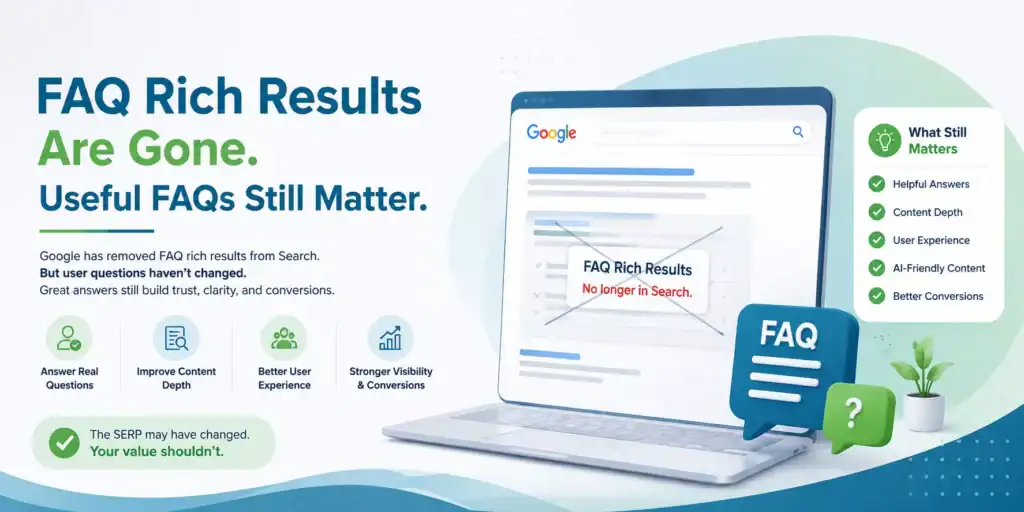
For years, FAQ sections did two jobs.
They helped users get quick answers, and when marked up with FAQPage schema, they sometimes helped websites earn larger search listings through FAQ rich results.
That second benefit is now gone.
Google has confirmed that FAQ rich results are no longer appearing in Google Search as of May 7, 2026. Google will also remove the FAQ search appearance, FAQ rich result report, and FAQ support in the Rich Results Test in June 2026. Search Console API support for FAQ rich result data will be removed in August 2026.
This does not mean FAQs are useless.
It means their SEO value has shifted from SERP decoration to user experience, content depth, and AI-friendly answers.
Quick Summary
Google has stopped showing FAQ rich results in Search. FAQ reports and Rich Results Test support will be removed in June 2026, and Search Console API support will end in August 2026. SEOs should keep useful FAQ content, audit outdated schema, update reporting dashboards, and focus on FAQs that improve user experience, conversions, and AI-friendly content clarity.
What Google Changed About FAQ Rich Results
Google’s update affects the visible rich result, not the idea of answering questions.
Previously, eligible pages using FAQ structured data could display expandable Q&A dropdowns directly in search results. Those extra lines often improved SERP visibility and sometimes helped CTR.
Now, the visual treatment is being removed from Google Search.
Here is the practical timeline:
| Date | What Changed |
|---|---|
| May 7, 2026 | FAQ rich results stopped appearing in Google Search |
| June 2026 | FAQ search appearance, FAQ rich result report, and FAQ support in Rich Results Test will be removed |
| August 2026 | Search Console API support for FAQ rich result data will be removed |
Google’s documentation still lists FAQPage structured data, but FAQ rich result support is being removed from Google Search.
Does This Mean You Should Remove FAQ Schema?
Not automatically.
If your FAQ schema markup accurately matches visible FAQ content on the page, removing it is not urgent. Google has historically said that unsupported structured data does not cause ranking issues when it is valid and not misleading.
But you should remove or simplify the FAQPage schema when:
| Situation | Recommended Action |
|---|---|
| FAQs are outdated | Update or remove them |
| Schema does not match visible page content | Remove or fix the markup |
| FAQs were added only to win rich snippets | Reassess whether the section still helps users |
| Automated reports depend on FAQ rich result data | Update dashboards before API support ends |
The key point: don’t delete useful FAQ content just because Google FAQ rich results are gone.
What You Should Avoid
- Do not remove every FAQ section just because the rich result is gone.
- Do not leave mismatched FAQ schema on pages where the questions and answers are no longer visible.
- Do not keep thin FAQs that add no value to the reader.
- Do not continue reporting FAQ rich result visibility as an active SEO KPI after the reporting support is removed.
Why FAQs Still Matter for SEO
FAQs still help because search behaviour has not changed as much as SERP features have.
Users still ask specific questions before they trust a page, a brand, or a recommendation. A strong FAQ section can reduce friction, answer objections, and support conversions.
For example, on a service page, FAQs can clarify:
- pricing doubts
- delivery timelines
- eligibility questions
- process confusion
- comparison concerns
On a blog, FAQs can answer related long-tail questions that the main article may not cover naturally.
So the role of FAQs is changing. They are no longer just a route to FAQ rich snippets. They are now part of a stronger content experience.
The New SEO Role of FAQ Content
The better question is not “Are FAQs still useful for SEO?”
The better question is:
Do these FAQs help users make a decision faster?
That is where FAQ content still earns its place.
A strong FAQ section now helps with:
| SEO / UX Function | Why It Matters |
|---|---|
| Search intent coverage | Answer secondary questions that users search for around the topic |
| Content depth | Adds clarity without bloating the main article |
| Conversion support | Removes doubts before inquiry or purchase |
| AI readability | Gives concise, extractable answers for AI search systems |
| Internal linking | Connects users to deeper pages naturally |
This is closely aligned with AI-first SEO and AEO. If you are building content for modern search, FAQs can still help AI systems understand the page’s context, provided the answers are clear and accurate.
You can connect this thinking with our blog on SEO in AI Search, where the larger shift is from ranking-only content to structured, trustworthy answers.
7 Smart Moves After FAQ Rich Results End
1. Keep Useful FAQs, Remove Thin Ones
Do not remove every FAQ section just because the rich result is gone.
Instead, audit the page.
If an FAQ answers a real question, supports buyer confidence, or improves topical coverage, keep it. If it exists only because someone wanted more SERP real estate, cut it.
A simple test works well:
Would this FAQ still help the reader if Google never saw it?
If yes, it belongs.
2. Stop Measuring FAQ Success by Rich Result Visibility
Many SEO reports used to track FAQ impressions through Search Console.
That reporting is going away. Google will remove the FAQ search appearance and rich result report in June 2026. API support follows in August 2026.
Update your reporting framework.
Instead of tracking FAQ rich result visibility, measure:
- page engagement
- scroll depth
- conversion rate
- assisted leads
- long-tail query coverage
- reduced support or sales questions
This is a better reflection of whether FAQs are actually useful.
3. Rewrite FAQs for People, Not Snippets
Many FAQ sections were written in a mechanical style:
Question: What is X?
Answer: X is X.
That format may have worked for rich snippets, but it often felt thin on the page.
Now, write FAQs like a helpful expert would answer them.
Good FAQ answers should be direct, but not empty. They should give enough context to help the reader decide what to do next.
Weak answer:
“FAQ schema helps SEO.”
Better answer:
“FAQ schema no longer earns visible FAQ rich results in Google Search, but FAQ content can still improve page clarity, support user decisions, and help structure answers for AI-driven search systems.”
4. Use FAQs to Strengthen AI-Friendly Content
AI search systems reward content that is easy to parse, summarize, and trust.
FAQs naturally help with this because they create clean question-answer blocks. But they need to be specific.
Instead of generic FAQs, use decision-focused questions:
- “Should I remove the FAQ schema from existing pages?”
- “Will this update reduce CTR?”
- “How should agencies explain this to clients?”
- “What should developers change in Search Console API dashboards?”
This approach supports an AI-first SEO strategy, especially when paired with structured headings and clear internal linking.
For deeper context, you can view our blog on Agentic engine optimization, because this update is another sign that content must work for both users and machine interpretation.
5. Update Technical SEO Workflows
Technical SEO teams should check more than page markup.
The bigger issue may be reporting dependencies.
If your dashboards pull FAQ rich result data from the Search Console API, those calls need to be reviewed before August 2026. Otherwise, reports may break or return incomplete data.
Your technical checklist should include:
| Area | What to Check |
|---|---|
| FAQPage schema | Is it accurate and visible on the page? |
| Rich Results Test workflow | Remove FAQ validation from testing routines |
| Search Console reports | Remove FAQ rich result reporting references |
| API dashboards | Update calls before August 2026 |
| Client reporting templates | Replace FAQ rich result KPIs with engagement or conversion metrics |
This is especially important for SEO agencies and tool builders.
6. Improve CTR Without FAQ Rich Snippets
Losing FAQ rich results does not mean losing all CTR opportunities.
You can still improve SERP performance through stronger metadata, clearer page titles, and better intent alignment.
Focus on:
- benefit-led title tags
- clearer meta descriptions
- freshness signals where relevant
- page titles that match actual user questions
- stronger brand recognition
For example, instead of relying on FAQ dropdowns to occupy more space, improve the core snippet:
Before:
“FAQ Schema Update – What You Need to Know”
After:
“FAQ Rich Results Are Gone: What SEOs Should Do Now”
The second title is clearer, more urgent, and more decision-focused.
You can view our blog on SEO Task Automation, especially where we discussed automating meta title and description testing.
7. Keep FAQs Where They Support Conversion
The highest-value FAQ sections are often not on blogs. They are on:
- service pages
- product pages
- pricing pages
- comparison pages
- lead-generation landing pages
These FAQs answer objections close to conversion.
For example:
- “How long does implementation take?”
- “What is included in the plan?”
- “Is this suitable for small businesses?”
- “Can I migrate later?”
- “What happens after I submit the form?”
These questions may never show as FAQ rich results, but they can still improve user confidence and lead quality.
What Website Owners Should Do Next
Here is the practical action plan:
| Priority | Action |
|---|---|
| High | Stop reporting FAQ rich result visibility as an active KPI |
| High | Update Search Console API dashboards before August 2026 |
| Medium | Audit pages where FAQs were added only for rich results |
| Medium | Rewrite FAQs to answer real buyer or reader questions |
| Medium | Keep useful FAQ sections for UX and AI readability |
| Low | Remove the FAQPage schema only where it is outdated, mismatched, or unnecessary |
The mistake would be treating this as “FAQs are dead.”
They are not.
The feature is gone. The user’s needs remain.
How to Explain This Update to Clients or Stakeholders
A simple explanation works best:
Google has stopped showing FAQ rich results, so we should no longer expect FAQ schema to improve SERP appearance. However, useful FAQ content still supports users, improves page clarity, and helps cover long-tail questions. We will shift reporting from rich result visibility to engagement, content quality, and conversion support.
This keeps the conversation calm and practical.
Final Thought
The end of the FAQ Rich Results is not the end of the FAQ content.
It is the end of treating FAQs as a shortcut to larger SERP listings.
The better strategy now is simple: keep FAQs where they help users, improve decision-making, and strengthen content clarity. Remove the ones that exist only for markup.
That is a healthier SEO approach anyway.
Search is moving toward usefulness, trust, and interpretation. FAQs still belong in that system—just not as a visual trick in the search results.
Frequently Asked Questions: FAQ Rich Results
What are FAQ Rich Results?
FAQ rich results were Google listings that showed expandable Q&A dropdowns using FAQPage schema.
When did Google remove FAQ rich results?
Google confirmed that FAQ rich results stopped appearing in Search on May 7, 2026.
Should I remove the FAQ schema from my website?
Not always. Keep it if it matches visible FAQ content. Remove it if it is outdated, mismatched, or unnecessary.
Will the FAQ schema still help rankings?
The FAQ schema no longer earns visible FAQ rich results. Its ranking impact should not be assumed.
Are FAQs still useful for SEO?
Yes. FAQs still support long-tail coverage, user experience, conversions, and content clarity.
What happens to the Search Console FAQ report?
Google will remove FAQ reporting in June 2026, with API support ending in August 2026.
Can I still test the FAQPage schema in Rich Results Test?
FAQ support in Rich Results Test is being removed, so it should no longer be part of rich result testing.
How can I improve CTR without FAQ rich snippets?
Improve title tags, meta descriptions, freshness, brand clarity, and search intent alignment.
Should agencies remove FAQ sections from client sites?
No. Audit first. Keep helpful FAQs and remove thin FAQs created only for rich results.
How does this affect AI-first SEO?
FAQs can still help AI-first SEO when they provide clear, accurate, and easy-to-extract answers.