
A growing number of teams are asking the same question regarding SEO in AI Search:
“If AI systems answer queries directly, does long-term SEO still matter?”
It’s a fair concern.
Traffic patterns are changing. AI Overviews reduce clicks for some searches. Content is being summarized instead of simply ranked.
But the bigger shift isn’t that SEO is disappearing.
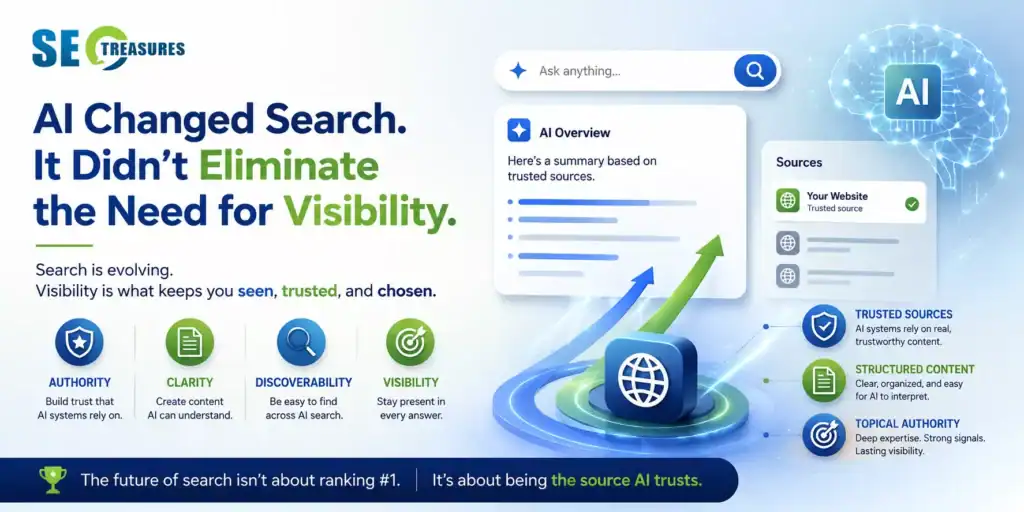
It’s that search visibility is evolving from ranking pages to becoming a trusted source within AI-driven systems.
That changes how SEO works—but not why it matters.
Businesses are now rethinking how long-term SEO strategies work in AI-driven search environments, especially as AI Overviews, conversational search, and large language models reshape how users discover information.
The Real Shift: Search Is Moving From Retrieval to Interpretation
Traditional search worked like this:
- User searches
- Google retrieves pages
- User clicks links
AI search changes the interaction.
Now:
- AI systems interpret intent
- Summarize information
- Select which sources to reference
This is why SEO in AI Search is becoming less about “position #1” and more about:
- authority
- clarity
- extractable information
Why SEO Still Matters in AI Search
AI systems still need:
- sources
- structured information
- trusted content ecosystems
They don’t generate expertise from nowhere.
They rely on existing web content to:
- learn patterns
- summarize insights
- generate answers
That means the websites producing:
- original insights
- structured explanations
- topical authority
still matter significantly.
Even AI-generated answers require reliable source material. Without authoritative web content, AI systems have nothing trustworthy to interpret, summarize, or reference.
What Actually Changes in AI-Driven Search Optimization
The long-term game isn’t disappearing.
The rules are changing.
Before:
Optimize pages for rankings.
Now:
Optimize content for:
- discoverability
- interpretability
- citation potential
This is where an AI-first SEO strategy becomes important.
1. Authority Matters More Than Volume
Publishing hundreds of shallow pages is becoming less effective.
AI-driven systems increasingly prefer:
- depth
- consistency
- topic expertise
Example
A focused website with:
- strong topical clusters
- structured explanations
- real expertise
can outperform larger sites with generic content.
This is especially visible in:
- SaaS
- finance
- healthcare
- B2B search
2. Search Intent Is Becoming Multi-Layered
AI systems don’t just match keywords.
They interpret:
- intent
- context
- follow-up relevance
A page targeting:
“Best CRM software”
now competes on:
- comparisons
- pricing
- use cases
- implementation
- industry fit
This is why search optimization for LLMs requires broader coverage—not just keyword targeting.
3. AI Overviews Reward Structured Content
Pages with:
- clear sections
- concise explanations
- logical formatting
are easier for AI systems to process.
This improves:
- AI search visibility
- inclusion in summaries
- extraction opportunities within AI-generated answers
That’s why:
- FAQs
- tables
- comparison sections
- definition-first writing
are becoming more important.
4. Topical Ecosystems Beat Isolated Pages
One strong article is no longer enough.
AI systems evaluate:
- topical consistency
- internal linking
- subject authority
This is where many websites struggle.
They publish disconnected content instead of building:
- topic clusters
- supporting content ecosystems
Example:
“A cybersecurity company publishing interconnected guides on compliance, threat detection, ransomware, and cloud security sends stronger topical authority signals than publishing unrelated high-volume articles.”
Many websites maintaining stable visibility in AI search are not necessarily publishing more content. They’re publishing clearer, more interconnected content around a focused expertise area.
This is especially noticeable in industries where trust and subject depth matter more than publishing volume alone.
The shift is moving from “more pages” to “stronger topical ecosystems.”
If you’re exploring this further, it connects closely with our analysis on:
These systems work together—not separately.
5. Human Trust Signals Matter More in AI Search
Ironically, AI search increases the importance of human trust.
Because AI-generated answers can feel generic, users increasingly value:
- recognizable expertise
- original thinking
- transparent sourcing
This changes the content strategy.
The goal is no longer:
“Produce more.”
It’s:
“Produce more trustworthy and reusable information.”
6. SEO Traffic May Shift—But Visibility Still Compounds
Yes, some informational queries may generate fewer clicks.
But visibility still creates:
- brand recognition
- authority
- downstream conversions
- demand generation
Important distinction:
AI search may reduce:
- low-intent clicks
But it can increase:
- qualified visibility
That’s why the future of SEO is less about traffic volume alone and more about:
- influence
- discoverability
- trusted presence
7. Long-Term SEO Strategy Is Becoming “Entity Strategy”
Search engines increasingly understand:
- brands
- authors
- companies
- products
as entities—not just keywords.
This means long-term SEO now includes:
- topical authority
- semantic relationships
- consistent brand positioning
This is one of the biggest strategic changes in the SEO and AI search era.
What SEO Teams Should Do Now
Instead of chasing every AI trend, focus on durable SEO fundamentals that improve both human trust and AI interpretability.
Prioritize:
- Deep topical coverage
- Clear and structured content
- Strong internal linking
- Original insights
- Regular content refresh cycles
Reduce dependence on:
- Thin scaling tactics
- Volume-first publishing
- Keyword-only optimization
Refresh aging content regularly to keep information accurate and aligned with evolving AI search behaviour.
Build consistent author, brand, and topical signals across your website to strengthen long-term search credibility.
Focus less on traffic volume alone and more on:
- visibility quality
- authority
- assisted conversions
Use summaries, FAQs, comparisons, and clear section hierarchy to improve extractability for AI systems.
Strengthen internal linking between related topics to build “stronger topical ecosystems”.
A Simple Way to Think About It
Old SEO asked:
“How do I rank?”
Modern SEO asks:
“Why would an AI system trust and surface this content?”
That’s the shift.
Final Thought
The long-term SEO game isn’t ending.
It’s becoming harder to manipulate with shortcuts.
AI search rewards:
- depth over scale
- clarity over manipulation
- authority over shortcuts
That’s actually good news for teams willing to build real expertise.
Because in the age of AI, trust becomes the ranking factor people remember—even when they never see the SERP.
Frequently Asked Questions: SEO in AI Search
Is SEO still relevant in AI search?
Yes. AI systems still rely on web content for information, context, and source validation.
What is SEO in AI Search?
It refers to optimizing content to perform well in AI-driven search environments, including AI summaries and conversational search systems.
Will AI Overviews reduce organic traffic?
For some informational queries, yes. But strong brands and authoritative sites can still gain visibility and influence.
How do AI Overviews affect SEO?
AI Overviews may reduce clicks for some searches, but authoritative and well-structured websites can still gain visibility through citations and trusted mentions.
What is LLM optimization?
LLM optimization means structuring content so AI systems can easily understand, interpret, and reference it.
Can AI-generated content rank in search?
Yes, if the content is useful, accurate, original, and reviewed by humans for quality and trust.
What is the difference between traditional SEO and AI SEO?
Traditional SEO focuses on rankings and keywords. AI SEO focuses more on authority, structure, clarity, and topical depth.
What is an AI-first SEO strategy?
An SEO approach focused on clarity, structure, topical authority, and machine-readable content.
How do AI systems choose which content to surface?
They tend to prioritize:
- trustworthy sources
- structured content
- complete answers
- topical relevance
Are keywords still important?
Yes, but intent, context, and content usefulness now matter more than exact keyword usage alone.
What type of content performs best in AI search?
Content that is:
- clear
- structured
- comprehensive
- easy to extract and summarize
How does internal linking help AI SEO?
Internal links strengthen topical relationships and help search systems understand authority across a website.
Should businesses change their SEO strategy because of AI?
Yes—but strategically. The focus should shift toward authority, clarity, and content ecosystems.
What is the biggest long-term SEO advantage in AI search?
Becoming a trusted source within your niche—not just ranking for individual keywords.