
The Google May 2026 Core Update is now complete.
That means the waiting period is over, but the reaction period should begin carefully.
If your rankings shifted, traffic dipped, or certain pages suddenly gained visibility, it’s time to stop guessing and start auditing. Core updates are not usually about one broken tag or one technical issue. They often reflect how Google is re-evaluating content quality, relevance, search intent, and overall usefulness across websites.
The practical question now is not:
“Did we get hit?”
The better question is:
Which pages changed, why did they change, and what should we improve first?
This guide outlines how SEO teams, website owners, agencies, and content teams should respond following the May 2026 core update rollout.
Use this as a practical post-update SEO checklist to audit ranking drops, diagnose traffic changes, and prioritise recovery work page by page.
7 SEO Recovery Moves After the Google May 2026 Core Update
After a broad core update, the goal is not to rewrite everything. The smarter approach is to identify what changed, understand why it changed, and improve the pages that matter most.
Here are the seven recovery moves SEO teams should prioritise:
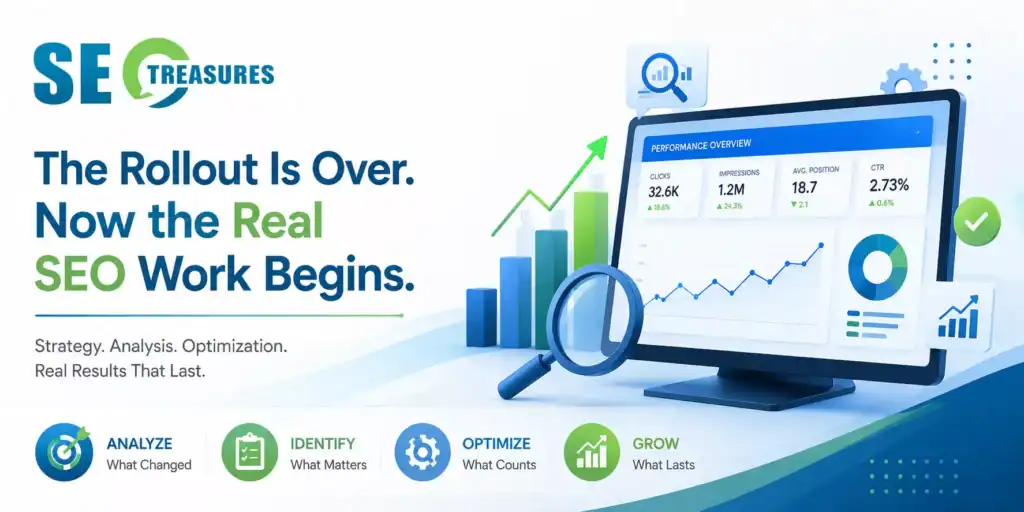
- Wait for stable Search Console data: Do not make major decisions based on rollout-period fluctuations. Review performance after the data has settled, then compare pre-update and post-update clicks, impressions, CTR, and average position.
- Identify affected pages and queries: Start with page-level analysis. Check which URLs gained or lost visibility, which queries shifted, and whether the drop is happening across the site or only on specific page types.
- Check whether search intent changed: Search results may change after a core update. A keyword that previously ranked blog posts may now favour product pages, forums, videos, comparison pages, or AI-driven answers. Before rewriting content, check what Google is currently rewarding.
- Audit content quality and usefulness: Review affected pages for search intent match, freshness, originality, examples, structure, trust signals, and decision value. Do not simply add more words. Improve how useful the page is for the user.
- Improve CTR where rankings stayed stable: If impressions are steady but clicks are down, the issue may be your title or meta description. Rewrite snippets to be clearer, more specific, and closer to the user’s search intent.
- Fix cannibalisation and technical friction: Check whether multiple pages are competing for the same query. Also review indexing, canonicals, internal links, page speed, mobile usability, schema, and crawl errors on affected sections.
- Build a page-level recovery plan: Prioritise pages based on business value. High-intent lead, sales, service, product, or category pages should be reviewed first. Assign each affected URL a clear action: improve, refresh, merge, redirect, internally link, or monitor.
Google May 2026 Core Update: What Changed After the Rollout?
The May 2026 update was Google’s second core update of 2026, following the March 2026 core update.
As with most broad core updates, Google did not target one specific issue. Instead, the update was designed to improve how Google evaluates and ranks content across search results.
For website owners, this means ranking changes may appear across different page types, including:
- blogs
- service pages
- product pages
- category pages
- comparison pages
- local landing pages
Some sites may see ranking drops. Others may see gains. Many may see mixed results, where a few pages improve while others decline.
That is why a page-level analysis matters more than looking only at total traffic.
Recovery Move 1: Wait for Stable Search Console Data
One common mistake after a core update is making fast changes too early.
Now that the rollout is complete, give your data enough time to settle before making major decisions. Google’s own guidance recommends waiting at least a full week after a core update completes before comparing Search Console performance.
This waiting period helps reduce false conclusions.
For example, a page may look like it lost traffic during the rollout, but the trend may stabilise after a few days. Another page may appear to recover temporarily before declining again.
Before rewriting content or changing templates, compare stable post-update data against pre-update data.
Recovery Move 2: Identify Affected Pages and Queries
Your first step should be a clean Search Console performance analysis.
Do not begin with assumptions like “Google punished us” or “AI content caused this.” Start with data.
Review:
| Area | What to Check |
|---|---|
| Pages | Which URLs gained or lost clicks? |
| Queries | Which keywords changed the most? |
| Impressions | Did visibility fall, or only CTR? |
| CTR | Did rankings remain, but clicks decline? |
| Average Position | Did pages drop significantly or slightly? |
| Device | Did mobile and desktop behave differently? |
| Country | Did losses happen in one market or globally? |
This helps separate ranking issues from click-through issues.
A page that lost impressions may need relevance or content improvement. A page that kept rankings but lost CTR may need stronger titles and descriptions.
Identify Pages Hit by Ranking Drops
Once you have your data, group affected pages into three categories.
1. Large Drops
These are pages with significant ranking and traffic loss.
They need a deeper review. Check whether the content is outdated, thin, generic, poorly structured, or weaker than competing pages.
2. Mild Drops
These pages may not need full rewrites. They may need smaller improvements, such as updated examples, better headings, internal links, or stronger answers to search intent.
3. Mixed Movement
Some pages may lose one query but gain another. This often means Google is shifting how it understands the page’s relevance.
For these pages, review whether the content has a clear primary intent or tries to answer too many unrelated queries.
Recovery Move 3: Check Whether Search Intent Changed
Sometimes a page drops not because it is bad, but because the search result has changed.
For example, a keyword that previously ranked blog posts may now show more product pages, comparison pages, forums, videos, or local results.
That means Google may now interpret the query differently.
Before rewriting a page, search the affected keyword and study the current SERP. Ask:
- Are informational pages still ranking?
- Are commercial pages now dominating?
- Are forums or user-generated results appearing?
- Are AI Overviews changing visibility?
- Are competitors answering the query more directly?
If the SERP has changed, your content format may need to change too.
This is where AI search optimisation becomes important. Pages need to be structured clearly enough for both users and AI-driven search systems to understand.
Recovery Move 4: Audit Content Quality and Usefulness
A strong SEO content audit should focus less on word count and more on usefulness.
Core updates often reward content that answers the query better than competing pages. That does not always mean longer content. It means clearer, more complete, more relevant content.
Review each affected page for:
| Content Check | Why It Matters |
|---|---|
| Search intent match | Does the page solve the user’s real problem? |
| Content depth | Does it answer follow-up questions? |
| Original value | Does it add insight beyond common summaries? |
| Freshness | Is the information still current? |
| Structure | Can users and search engines scan it easily? |
| Trust signals | Are claims supported, specific, and credible? |
| Internal links | Does it connect to relevant supporting pages? |
If you already have a Google core update recovery checklist, this is the section where it should be applied page by page.
Review Helpful Content Signals
The May 2026 core update should be treated as another reminder to improve content quality.
A strong, helpful content strategy focuses on whether the page genuinely helps the user make progress.
Weak content often has patterns like:
- generic introductions
- repeated points
- vague advice
- outdated screenshots
- thin comparisons
- over-optimised keywords
- no real examples
- weak author or brand trust
Better content usually has:
- clear answers
- practical examples
- updated data
- comparison tables
- decision-support sections
- FAQs that answer real doubts
- strong internal links
- visible expertise
If a page loses traffic, do not simply add more words. Improve the decision value.
Recovery Move 5: Improve CTR Where Rankings Stayed Stable
Not every post-update problem is a ranking problem.
Sometimes impressions remain stable, but clicks fall. That means your snippet may no longer be winning attention.
This is where you should work on how to improve organic CTR.
Review titles and meta descriptions for affected pages. Make them clearer, more specific, and closer to user intent.
For example:
Weak title:
“SEO Update Guide”
Better title:
“May 2026 Core Update: How to Audit Ranking Drops”
Weak meta description:
“Learn about the latest Google update and SEO tips.”
Better meta description:
“Use this May 2026 core update checklist to analyse ranking drops, audit weak pages, and improve content after the rollout.”
CTR improvements can recover traffic without needing major ranking gains.
Recovery Move 6: Fix Cannibalisation and Technical Friction
After a core update, Google may choose a different page from your site for the same query.
This is why a keyword cannibalisation audit is useful.
Look for situations where:
- Two pages target the same keyword
- Multiple blogs answer the same intent
- A category page competes with a guide
- A service page competes with an informational article
If Google is confused about which page is most relevant, rankings can become unstable.
Fix this by consolidating overlapping content, improving internal links, clarifying page intent, or redirecting weak duplicate pages where appropriate.
Do Not Ignore Technical SEO
Core updates are mostly about ranking systems, but technical issues can make recovery harder.
Run a technical SEO checklist on affected sections of the site.
Check:
| Technical Area | What to Review |
|---|---|
| Indexing | Are key pages still indexed? |
| Canonicals | Are canonical tags correct? |
| Internal links | Are important pages receiving enough links? |
| Page speed | Is slow performance affecting engagement? |
| Mobile UX | Are pages usable on mobile devices? |
| Schema | Is structured data valid and relevant? |
| Crawl errors | Are important URLs blocked or broken? |
Technical SEO may not be the direct cause of a core update drop, but fixing technical friction helps Google process and evaluate your content more effectively.
Recovery Move 7: Build a Page-Level Recovery Plan
After your analysis, create a recovery plan instead of making random edits.
Prioritise pages based on business impact.
High Priority
Pages that drive leads, sales, subscriptions, or high-intent traffic.
Medium Priority
Pages that support topical authority or assist conversions.
Low Priority
Old, low-impact posts with limited traffic or unclear purpose.
For each page, define the next action:
| Issue | Action |
|---|---|
| Thin content | Expand with useful depth and examples |
| Intent mismatch | Reframe page structure |
| Outdated info | Refresh data, screenshots, and recommendations |
| Weak CTR | Rewrite title and meta description |
| Cannibalisation | Merge, redirect, or clarify target intent |
| Poor structure | Improve headings, tables, and internal links |
This makes recovery measurable.
If your highest-value pages lost traffic after the update, start with a focused recovery audit instead of making random content edits. Prioritise pages that drive leads, enquiries, sales, or high-intent organic traffic.
How to Explain the Update to Clients or Stakeholders
For agencies and in-house teams, communication matters.
Avoid saying:
“Google hit us.”
Say:
“The May 2026 core update has changed how some pages are being evaluated. We are comparing pre-update and post-update data, identifying affected pages, and prioritising improvements based on traffic and business impact.”
This sounds calmer, more accurate, and more action-oriented.
A simple reporting structure works well:
- What changed
- Which pages were affected
- Which queries shifted
- What we believe caused the change
- What we are improving next
- When will we review progress again
This builds confidence without overpromising recovery timelines.
How This Connects With AI-First SEO
The May 2026 update also fits into a larger shift happening across search.
Google Search is increasingly driven by systems that interpret meaning, content quality, usefulness, and intent rather than relying only on keyword matching. AI Overviews and AI-driven search experiences make this even more important.
That means your content should be:
- clear
- structured
- trustworthy
- easy to summarize
- aligned with search intent
- connected to a broader topic cluster
This is why SEO teams should connect post-update recovery with broader AI search optimisation work.
The future of SEO is not just ranking pages. It is building content that users and search systems can trust.
Need Help Diagnosing a Google Core Update Traffic Drop?
If your rankings or organic traffic changed after the May 2026 core update, start with a page-level audit before making major edits. Review affected URLs, changed queries, CTR shifts, search intent changes, content quality, internal links, and technical issues.
A structured SEO audit can help identify whether the issue is weak content relevance, poor CTR, keyword cannibalisation, outdated information, technical friction, or a shift in search intent.
Need clarity on what changed? Start with a page-level SEO audit of your highest-value URLs before making major content changes.
Recommended Reading for SEO Recovery
To build a stronger recovery plan, you can also review related SEO guides on content quality, CTR improvement, keyword cannibalisation, technical SEO, and AI search optimisation. These supporting topics can help you identify whether the issue is ranking loss, weak snippets, intent mismatch, overlapping pages, outdated content, or technical friction.
Final Thought
The Google May 2026 Core Update is complete, but your response should be measured.
Do not rewrite everything.
Do not panic over daily fluctuations.
Do not assume one fix will recover every page.
Start with data. Identify which pages changed. Compare intent. Improve weak content. Fix CTR issues. Strengthen internal links. Review technical SEO. Then measure again.
Core updates tend to favour websites that keep improving content quality, usefulness, intent alignment, and trust.
That is the real recovery strategy.
Frequently Asked Questions: Google May 2026 Core Update
What is the Google May 2026 Core Update?
The Google May 2026 Core Update is a broad ranking update designed to improve how Google evaluates and ranks content across search results.
When did the May 2026 core update complete?
The rollout was completed on June 2, 2026, after starting on May 21, 2026.
Why did my rankings drop after the update?
Ranking drops may happen when Google re-evaluates content quality, relevance, search intent match, topical authority, or competing pages.
How soon should I analyse traffic changes?
Wait at least one full week after the rollout completes before making conclusions from Search Console data.
What should I check first after a core update?
Start with Search Console. Compare affected pages, queries, impressions, clicks, CTR, and average position before and after the update.
How do I recover from a Google core update?
Audit affected pages, improve weak content, align with search intent, update outdated sections, fix technical issues, and strengthen internal links.
Should I delete pages that have lost rankings?
Not immediately. First, check whether the page can be improved, merged, redirected, or repositioned based on its search intent and business value.
What is the biggest lesson from the May 2026 core update?
The main lesson is to focus on useful, intent-aligned content rather than reacting with rushed edits or keyword-heavy rewrites.