
Most SEO professionals think the shift from agency to in-house is about control.
It’s not.
It’s about context.
The mistake most teams make?
They change the structure—but not how they work.
In an agency, you optimize for multiple clients, limited access, and defined scopes.
In-house, you operate inside the business—where SEO decisions affect product, sales, and revenue directly.
That shift changes how you think, prioritize, and measure success.
If you’re deciding between in-house SEO vs agency SEO, or planning a transition, these lessons will help you avoid common mistakes.
Who this guide is for:
- SEO professionals moving in-house
- Founders deciding between hiring vs agency
- Marketing heads scaling organic growth
In-House SEO vs Agency SEO (Quick Answer):
In-House SEO:
- Full control
- Faster execution
- Stronger long-term ROI
Agency SEO:
- Faster setup
- Access to specialists
- Easier short-term scaling
The right choice depends on whether your priority is control or speed.
If SEO is already driving growth, go in-house.
If you need momentum fast, start with an agency.
What is In-House SEO vs Agency SEO?
In-house SEO refers to managing SEO internally within a company, aligning it directly with product, marketing, and revenue goals.
Agency SEO involves outsourcing SEO to an external team that manages strategy and execution across multiple clients.
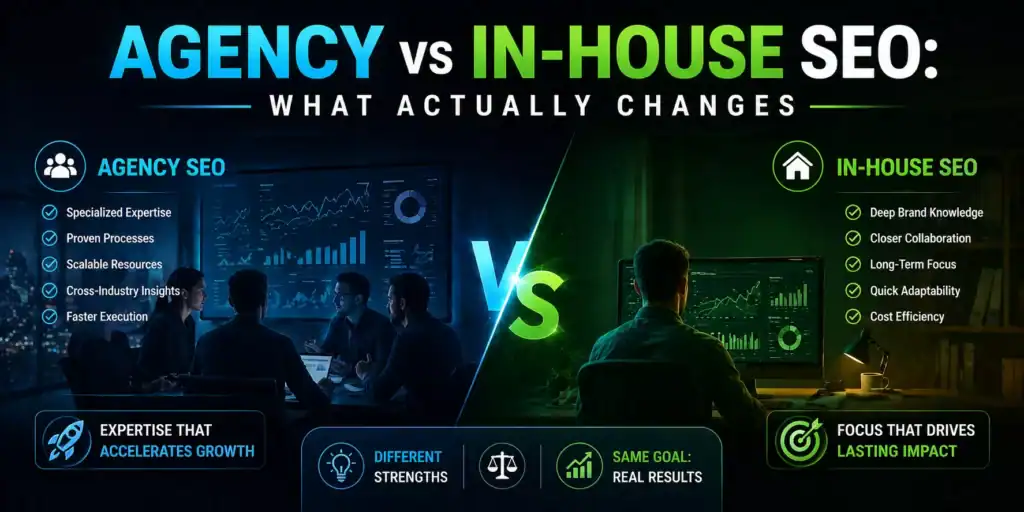
This highlights the key difference between in-house SEO and agency SEO—control vs scalability.
Here’s how that difference plays out in real SEO work:
1. SEO Becomes a Business Function, Not Just a Channel
In an agency setup, SEO is often scoped as:
- Traffic growth
- Rankings
- Deliverables
In-house, SEO becomes tied to:
- Revenue impact
- Product performance
- Customer acquisition
What changes:
You’re no longer asking:
“Are we ranking?”
You’re asking:
“Is SEO contributing to business outcomes?”
This shift changes how SEO is measured and owned.
2. Access Changes Everything
Agency teams work with:
- Limited backend access
- Delayed implementation cycles
- Dependency on client approvals
In-house teams have:
- Direct CMS control
- Faster execution
- Real-time testing ability
Example
Fixing internal linking:
- Agency: recommend → wait → follow up
- In-house: implement → test → iterate
This directly affects SEO execution in-house vs agency.
3. Strategy Depth Increases (But So Does Responsibility)
Agency SEO strategy often focuses on:
- Scalable deliverables
- Repeatable workflows
An in-house SEO strategy requires:
- Deep product understanding
- Customer journey mapping
- Cross-channel alignment
You move from:
- Task execution
To:
- Strategic SEO execution tied to growth
4. Cross-Team Collaboration Becomes Critical
This is where many transitions fail.
In-house SEO depends on:
- Product teams
- Developers
- Content teams
- Sales & marketing alignment
Reality:
If you can’t collaborate, you can’t execute.
This is why business-aligned SEO matters more than technical expertise alone.
5. ROI Expectations Are Higher—and Clearer
In agency SEO:
- ROI is often indirect
- Reporting focuses on metrics
In-house SEO:
- Budget decisions depend on measurable impact
- SEO must justify its role in growth
You’re evaluated on:
- Contribution to the pipeline
- Revenue influence
This is where SEO ROI in-house vs agency becomes visible.
6. Workflow Structure Is Completely Different
Agency SEO workflow:
- Defined deliverables
- Multiple clients
- Standardized processes
In-house SEO workflow:
- Flexible priorities
- Ongoing experimentation
- Internal dependencies
Example
Content production:
- Agency: deliver X blogs/month
- In-house: publish what drives results
This directly changes how SEO projects are planned and executed.
7. Scaling SEO Looks Very Different
Scaling in an agency:
- Add more clients
- Expand services
Scaling in-house:
- Build systems
- Automate workflows
- Improve efficiency
This is where SEO task automation becomes essential—especially for handling repetitive work like reporting, clustering, and audits.
At this point, the difference isn’t tactical—it’s operational.
You’re not just changing how SEO is done.
You’re changing how decisions are made.
The transition sounds straightforward—but this is where most teams get it wrong.
Thinking of moving in-house?
Start by auditing what SEO decisions require:
- Product access
- Developer support
- Content control
If you don’t control these yet, you’re not ready for full in-house SEO.
Common Mistakes When Moving SEO In-House
Many teams struggle with the transition—not because of SEO knowledge, but because of execution gaps.
- Treating SEO Like an Agency Deliverable: Expecting fixed outputs (like X blogs/month) instead of focusing on outcomes and impact.
- Ignoring Cross-Team Dependencies: SEO execution depends on developers, product teams, and content—lack of alignment slows everything down.
- Expecting Immediate ROI: In-house SEO takes time to build momentum. Early expectations are often unrealistic.
- Not Building Systems Early: Without workflows, documentation, and automation, SEO becomes inconsistent and hard to scale.
- Underestimating Strategy Depth: In-house SEO requires deeper thinking—customer journey, product alignment, and business impact.
Key takeaway:
Moving in-house isn’t just a structural shift—it’s an operational one. Success depends on systems, collaboration, and realistic expectations.
In-House SEO vs Agency SEO: Pros and Cons
Here’s a side-by-side comparison to help you quickly evaluate both models:
Key Takeaway
In-house SEO gives you control and long-term leverage, while agency SEO offers speed and flexibility.
Now that you understand the trade-offs, the real question is when each model makes sense.
When Should You Move SEO In-House?
Not every business should.
Consider moving in-house when:
- SEO is a primary growth channel
- You need faster execution
- Product/content integration is critical
Stay with an agency when:
- You lack internal expertise
- SEO isn’t a core priority yet
- You need specialized skills
This is the real decision behind
“Should you hire an SEO agency or build in-house?”
Cost Comparison: In-House SEO vs Agency SEO
There’s no one-size-fits-all answer—but the cost structure is very different.
In-House SEO Cost Includes:
- Salaries {~(₹6L–₹30L+) depending on role and experience}
- SEO tools and software {~(₹10K–₹1L/month)}
- Hiring, onboarding, and training time
Agency SEO Cost Includes:
- Monthly retainers {~(₹25K–₹2L+ depending on scope)}
- Project-based pricing (audits, migrations, content, etc.)
Key Insight:
- In-house SEO usually means higher upfront investment but stronger long-term control and ROI.
- Agency SEO offers faster setup, lower initial commitment, and flexible scaling.
The real cost difference isn’t what you spend—it’s how quickly SEO starts impacting revenue.
Quick Decision Framework: In-House SEO vs Agency SEO
Once you understand the costs, the next step is choosing the right model for your current growth stage.
Use this simple framework to decide which model fits your business right now:
Choose In-House SEO if:
- SEO is a core revenue or acquisition channel
- You need faster execution and direct control
- Product, content, and SEO need tight integration
- You’re building long-term organic growth
Choose Agency SEO if:
- You need faster results without hiring internally
- You lack in-house SEO expertise
- SEO is not yet a primary growth channel
- You need specialized skills or short-term support
Best of Both (Hybrid Model):
- The in-house team owns the strategy and direction
- Agency supports execution, scale, or specialized tasks
Key takeaway:
- Choose in-house for control and long-term growth.
- Choose an agency for speed and flexibility.
- Use a hybrid model when you need both.
Team Structure: In-House vs Agency
In-house SEO team roles:
- SEO strategist
- Content lead
- Technical SEO
- Analyst
Agency SEO team structure:
- Account manager
- SEO specialist
- Content team
- Technical support
The difference isn’t just roles—it’s ownership.
Moving from Agency to In-House SEO: Quick Checklist
- Audit current SEO performance and dependencies
- Identify what should stay in-house vs outsourced
- Set clear KPIs tied to revenue, not just traffic
- Build workflows (reporting, content, technical fixes)
- Align with product, dev, and marketing teams early
- Plan a 3–6 month transition, not an overnight switch
Final Thought: It’s Not Agency vs In-House. It’s Fit vs Misfit.
The debate around in-house SEO vs agency SEO is often framed incorrectly.
It’s not about which is better.
It’s about:
- Your growth stage
- Your internal capabilities
- Your need for control vs speed
Some of the strongest SEO setups combine both:
- In-house for strategy and ownership
- Agency for execution and scale
Soft CTA
If you’re evaluating in-house SEO vs agency SEO, start with one question:
What does your business need more right now—control or speed?
Your answer usually points to the right model.
If you’re still unsure, start with a hybrid approach—build strategy in-house and outsource execution. Then evaluate performance after 3–6 months.
Frequently Asked Questions: In-House SEO vs Agency SEO
What is the main difference between in-house SEO and agency SEO?
In-house SEO operates within a business and aligns directly with product and revenue goals, while agency SEO typically focuses on delivering defined SEO services across multiple clients.
Is in-house SEO better than agency SEO?
It depends on the business stage. In-house works better for long-term growth and control, while agencies are useful for speed and specialized expertise.
When should a company move SEO in-house?
When SEO becomes a core acquisition channel and requires deeper integration with product, content, and marketing teams.
What are the benefits of in-house SEO?
Better control, faster implementation, deeper business alignment, and stronger long-term strategy execution.
What are the advantages of an SEO agency?
Access to specialized skills, faster onboarding, scalability, and an external perspective.
How does SEO ROI differ between in-house and agency setups?
In-house SEO often delivers stronger long-term ROI due to alignment and control, while agencies provide quicker short-term execution.
What skills are required for an in-house SEO team?
Strategic thinking, technical SEO, content planning, data analysis, and cross-team collaboration.
How does workflow differ in-house vs agency SEO?
In-house workflows are flexible and integrated with internal teams, while agency workflows are structured around deliverables and timelines.
Can businesses use both in-house and agency SEO?
Yes. Many companies use a hybrid model—internal teams for strategy and agencies for execution or scale.
What is the biggest challenge when moving SEO in-house?
Adapting to cross-team collaboration and aligning SEO with broader business goals.
Which is better for startups: in-house SEO or agency SEO?
Startups typically benefit more from agency SEO due to faster execution and lower initial investment. As SEO becomes a core growth channel, transitioning in-house or adopting a hybrid model becomes more effective.